




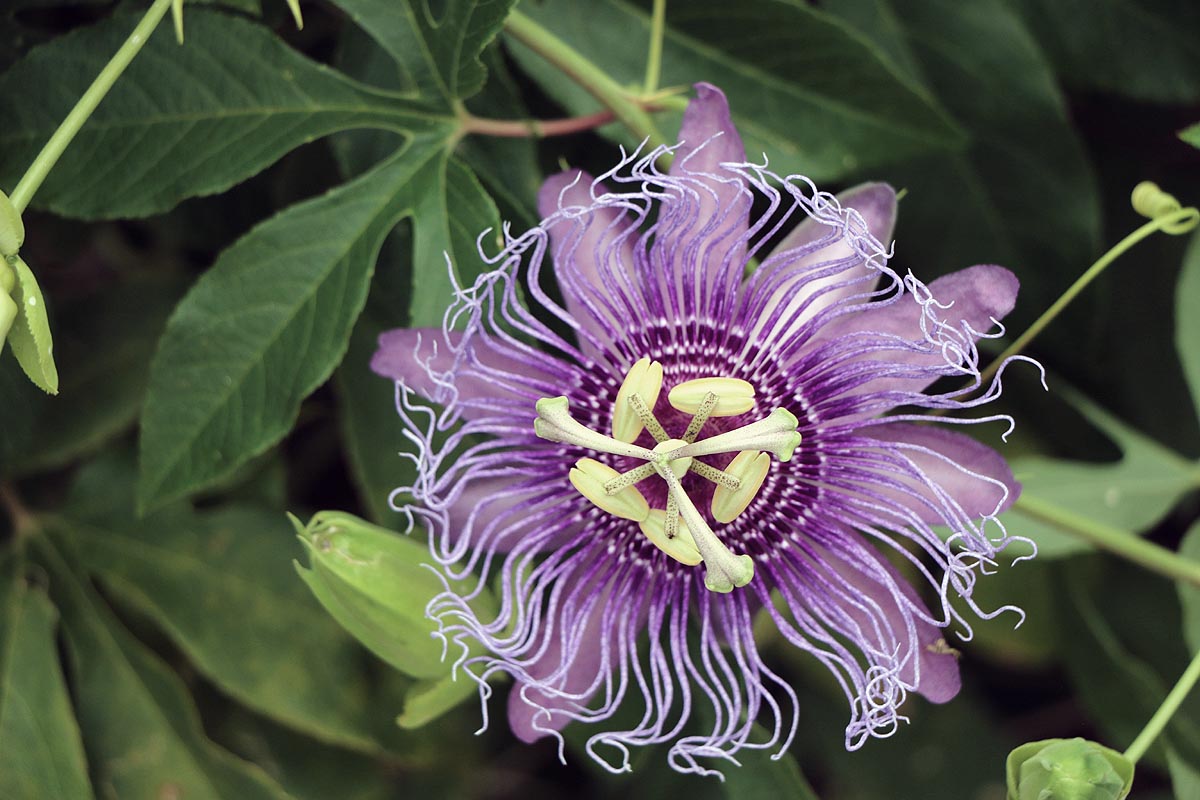
Passion vines are an extremely exotic flower with a wonderful aroma that can fill a small garden. Large complex flowers last only one day but are always a talking point. Makes a great small pot plant for the deck where its aroma can be appreciated. A perennial vine it does best in pots where root restriction produces more flowers. Can be planted in the ground to zone 6 where it will die back in winter but in warmer zones down to 11 it will stay green and flowering all year. Vigorous vine needs climbing support in full sun but is not really fussy about soil type. Plants are very long lived once established and take little care except cutting back in winter. Little fussy to start but easy once established. Butterflies love the flowers, so do hummingbires wildlife may eat it espeically the edible fruits.
Description of Purple Passionflower / Maypop (Passiflora incarnata).
Maypop is a native American perennial vine. In zones 8-11 it is most commonly a perennial vine in zones 6-8 the vines die down to the ground in the winter but will regrow from the rootstocks in the spring popping out of the ground once again in May - hence the name. Maypop although a vigorous vine is not as large as many other species of passion flower growing to about 12 feet in length so its much easier to control than other vines.
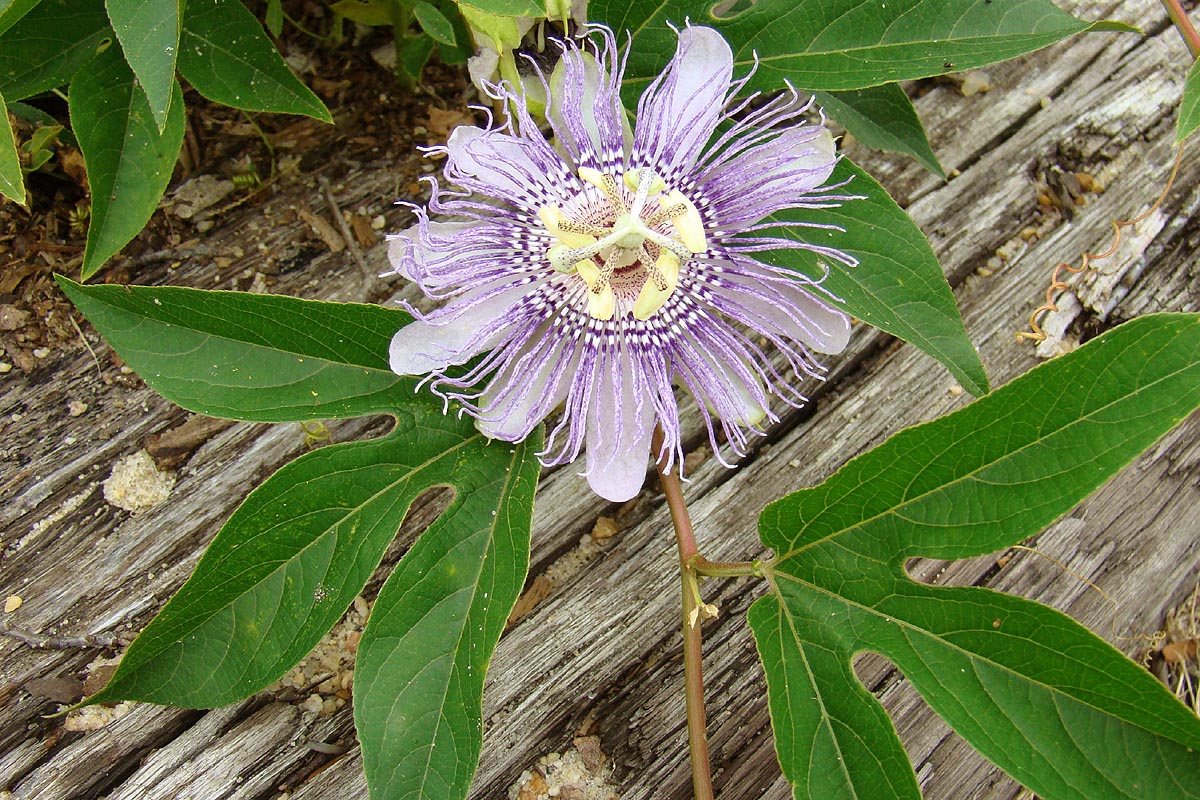
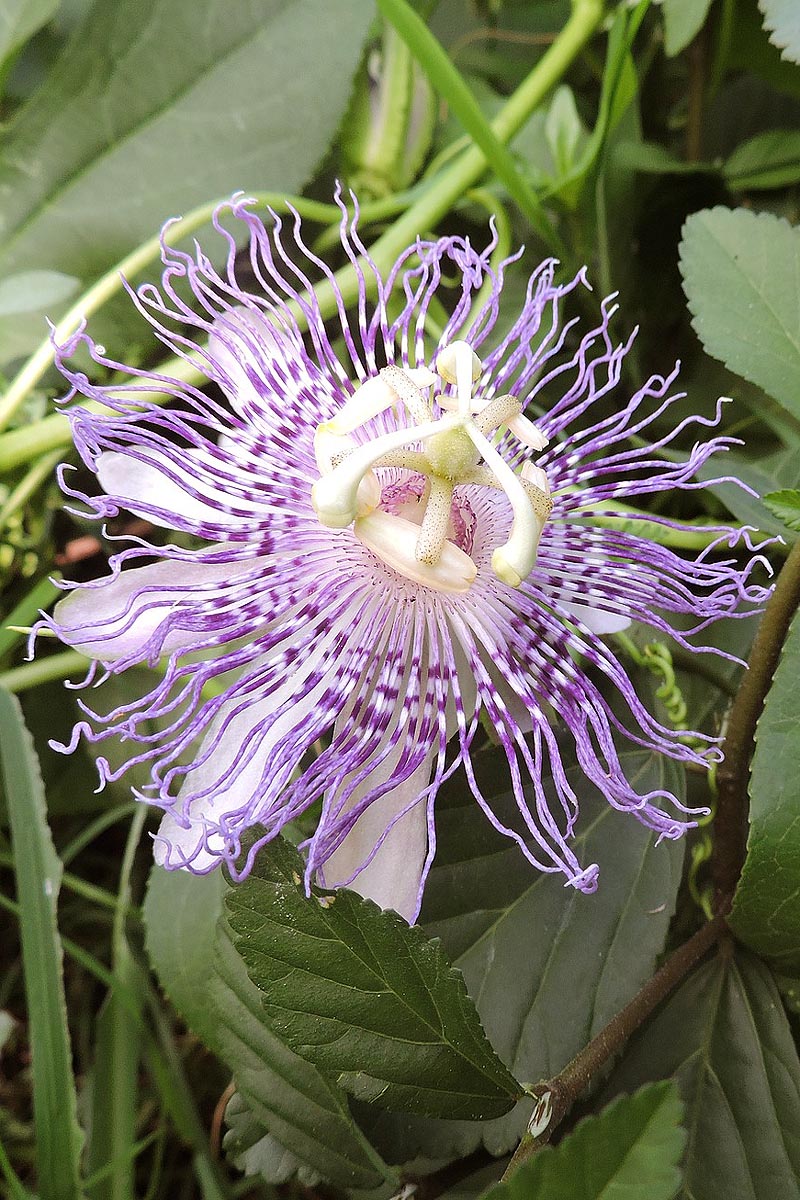
The mid green leaves are deeply three lobed (palmate) with finely serrated margins from 3 - 6 inches (6 -1 5cm) long and equally as wide. They are attached to the main stem alternately by a short bare stalk. Flower stalks will arise from each leaf node towards the end of the stem and flower singly with one flower closing before the next opens. Each flower lasts only one day. Flowers are large about 4-5 inches across and very complex. They have an outer ring of pale lavender petals usually 10 in number, these are long ovals backed by light green sepals. The outer petals are overlaid by a corona of fringe-like strands that form a ring or crown. These can be lavender, purple or white but are most commonly a banded combination of all three. They can also be straight or slightly curled. The center of the flower is dominated by large stamens and stigma that protrude high above the flat plain of the petals and are arranged in a complex triangular pattern more reminiscent of a radar detection antenna.
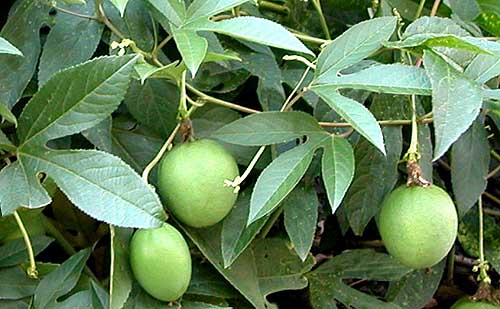
Flowers produce an extremely sweet smelling aroma that can be detected from considerable distance away. Will bloom from early summer until late fall in temperatures stay warm enough. Flowers are followed by globe shaped fruits about the size and shape of a small hens egg. Green initially turning slightly yellowish when ripe. When opened the seeds are embedded in a yellowish pulp that has a strong unique flavour.
Growing Purple Passionflower / Maypop (Passiflora incarnata) from Seed.
Maypop seeds are a little bit fussy about germination. Seeds tend to die quickly so having seeds from the last season is essential. Seeds also need a period of cold before they will germinate.
All our seeds come from the last season and we keep them in cold storage under slightly moist conditions that mimic being in the fruits so they are in the best condition when you order them.
IMPORTANT. Keep all the seeds in the refridgerator until you are ready to proceed. We recommend you start this early to ensure you have some for cold stratification to increase your likelihood of good germination.
These seeds have a very hard seed coating that needs to be scarified to allow water to enter and swell the seed embryo before they will germinate. There are many different methods suggested from using hard acid to hot water and sharp knives. However we find that the Sandpaper Method works the best and its safe and easy for you to do without injury.
Once seeds have been scarified soak them in slightly warm water, not hot for at least 24 hours. Check to see if they have swelled. If they have they are ready to be planted. If not they will need a little more work with the sandpaper to get through that seed coating.
If you have a good number of seeds we recommend that you divide them in half and put one set back in the refridgerator in a small plastic box with either damp sterile sand or damp paper towels for at least three weeks. If using paper towels check regularly to ensure that the seeds do not form mold.
The other half can be planted immediately.
If you wish you can use a plastic zip lock bag with sand to store your seeds. We do not recommend this method because if a seed does start to germinate removing it can damage or even destroy the delicate roots and shoots and the seed is lost.
Sowing. Seeds are reasonably large so planting in small pots individually or in medium sized individual cell trays is best. This ensures that each seed can develop in its own time without disturbing others that have not germinated yet.
Place seed pots in a warm area about 68° - 75°F. (20°-24°C) so sources suggest using bottom heat which can be done with heating mats but bare in mind that watering will need to be much more frequent as the seeding mix will dry out very quickly with bottom heat. Once or even twice a day may be necessary.
For most placing near a warm window next to a radiator is usually good enough as long as the temperature stays reasonably constant. Keep seeding mix moist at all times.
Some sources suggest placing plastic over the top of the mix to keep in moisture, we find that this can encourage damping off fungus, often in the roots so the poor seed never gets a chance to even show a shoot. Water molds are very fond of these conditions and it's the major problem with all seed production we do not recommend it.
Germination can still be erratic. Some seeds may sprout in as little as two weeks while others may take up to six months to show themselves. Be patient and keep pots moist at all times. This is the main reason for planting seeds in individual cells or pots so those that sprout can be moved to larger pots without disturbing the ungerminated ones. Once seedlings to appear if in individual pots grow on until they are at least 6 inches (cm) tall before transplanting. Grow vines on until they reach 12-14 inches (cm) tall before planting in desired outdoor location. Ensure plants are well hardened off and strong in the sunlight before transplanting out.
While vines can be left to climb up trees bear in mind that it will be very detrimental to the tree often covering a lot of its foliage and possibly killing the tree if not well controlled.
using a trellis, fence or other structure to support the vines works best. Maypop climbs by using tendrils that it wraps around things it finds. It cannot cling to a brick wall or other structure that does not provide 'handholds' for it. Use a wire trellis, wire fence or support using strings or such like for the vines to cling on to and climb.
Maypop makes a wonderful summer screen or fence and it allows the flowers to be seen and the aroma noticed. Trellising is essential if the objective is to harvest leaves.
Our vines usually cover about 14 feet (m) of trellis per vine. This is in zone 7b.
Climate. Maypop will grow from zone 6a all the way down to zone 11. Therefore its behavior will change with its location. In colder zones 6-7b maybe 8a it will die back to the ground in the winter months and 'pop' out of the ground in springtime. While the name states May it could be sooner or later depending on your location. In warmer zones 8-9 it may keep some green stems and just 'tick over' in the winter months beginning to grow as the temperatures rise in spring. zone 10 onwards it usually behaves as a perennial staying green all the time and flowering continuously. In these zones keeping it under control is more important as it will grow quite quickly and can overrun the garden if not contained.
Light. Maypop likes lots of light and does not do well in shaded areas. It prefers at least 608 hours of direct sunlight for optimal flowering. In cooler more shaded locations it will grow more slowly and may not flower much at all. However it can have too much and in warmer zones 9-11 a little shade from noon sun is beneficial to prevent leaf scorch.
Soil. Needs a well drained soil will not grow in constantly wet soils. However it can tolerate soils that hold water for brief periods and even do reasonably well in rain gardens. However if the soil remains wet for longer than a few days the roots can rot and the plant dies.
Does not seem to have much issue with pH growing in both fairly acidic soils as well as neutral and somewhat in the alkaline. Provided your soil is not radically at one end of the scale it should do just fine. Any soil type that is not waterlogged or compacted seems fine although it will do better if some compost is dug in before planting.
Water. While Maypop is fairly drought tolerant once its established because it produces deep roots prolonged drought will reduce the growth, leaves may die back and flowering will stop. For best results a regular watering schedule is recommended a soaker hose along the bottom of vines works very well. Of course if vines are in pots daily watering will be required. These plants produce a lot of leaves so lots of water will be needed for potted plants.
Location. Vines produce deep roots to pull nutrients and water from deep in the soil so they really don't like being dug up and moved once established so choose your location with care. Where and how you grow your vines will depend on your reason for growing them. Do you just want to enjoy the plant, do you want flowers, fruits or leaves? There are ways of increasing each depending on your requirements.
To get flowers produced from unrestricted plants, they need to be grown in full sun in well drained fairly poor soil If the plant is stressed it is more likely to produce flowers. If the soil has good organic material and is rich you will only get leaves.
While fruits are produced throughout the range warmer zones will have fruit ripening more easily. Up to zone 8 fruits ripen from mid summer onwards. In zones 7b and above fruits tend not to begin ripening until late fall and often into early winter. Ripe fruit turn a golden yellow color while unripe fruits are green. In cooler zones unripe fruits may need to be picked before frost arrives and brought in to finish ripening as the warm season is not sufficient to complete the task. We have some maypops on one of our hoop house and even there where the vines stay green far longs not all the fruit will ripen and needs to be gathered and brought into ripen. They are very aromatic during the process and no air freshener is ever needed.
Harvest fruits as they turn golden color. If fruits are not ripe by time the frost comes collect all the fruits and ripen them inside the home. This will be common practice in zones 7b and colder.
Edible Uses of Purple Passionflower / Maypop (Passiflora incarnata).
The fruits are the main edible portion. While P. incarnata is not as delicious as the tropical passion fruit sold in stores it is still a pleasant fruit. It is the pulp that surrounds the large seeds that is used and needs to be carefully removed from the seeds before being used to flavor desserts, smoothies, drinks, jams, jellies and other delicacies.
The young leaves and shoots can also be eaten either cooked as a vegetable or in salads. The flowers can also be eaten but have such a strong aroma that they tend to overwhelm other ingredients and should be used sparingly.
The plant is also used for a large number of other reasons, including irritable bowel syndrome, pre-menstrual tension, vaginal discharges and mild reduction of blood pressure.
The roots are also used as poultice to treat boils, cuts and wounds. An infusion of the roots is used to treat earache and inflammation and as a tonic for liver problems.
Should not be mixed with central nervous system depressants such as alcohol as it may induce Hypersensitivity