






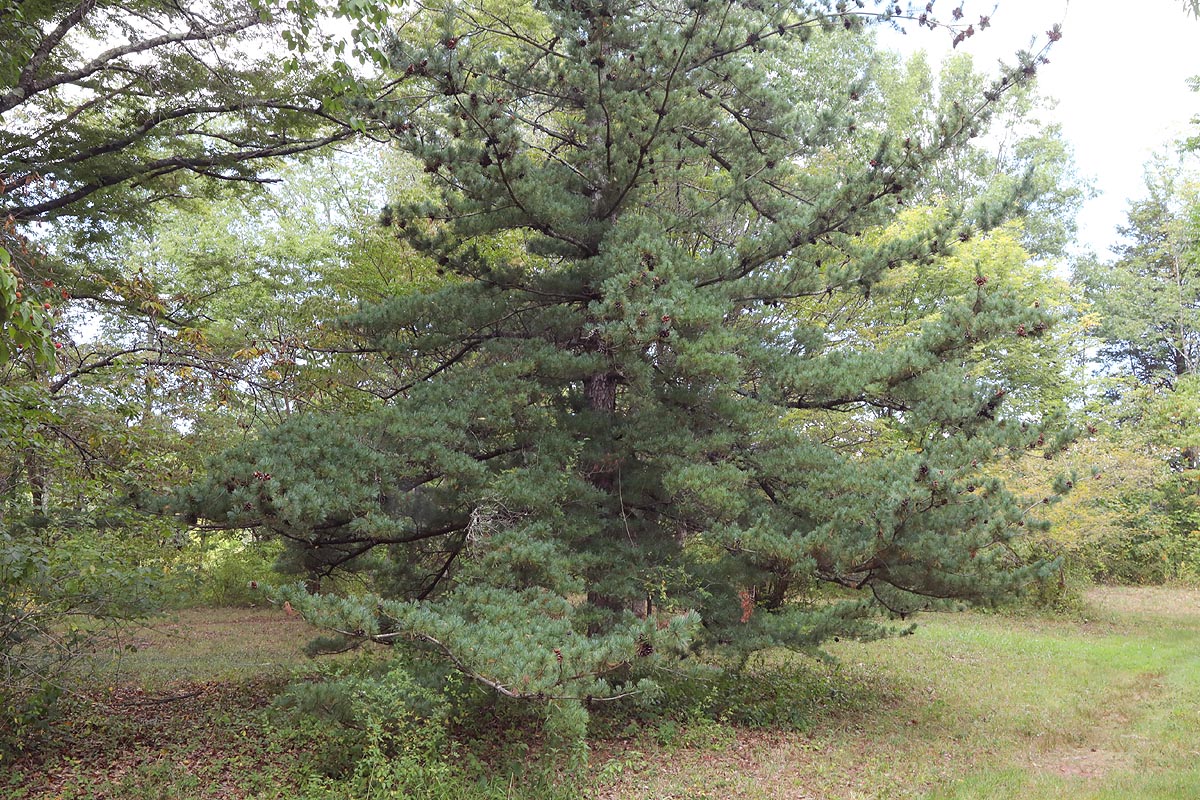

Majestic pine tree with tufted clumps of thick needles that are much stouter than the regular North American White Pine. This species does not grow as fast as the regular white pine normally seen in North America. This means the wood tends to be slightly harder and the shape makes it less prone to snapping when there is snow load. North American White Pines can be dangerous as they do tend to shed large branches during snow and even snap across the trunks. This tree is far less prone to that. It also will produce branches that can droop down towards the ground given enough space to grow. This means if the intention is to collect the edible pine seeds they are far more accessible than the regular white pine where the seeds tend to be at the top of the tree. In its native Japan this tree is associated with auspiciousness and longevity, as the do live a long time and dont tend to snap and fall. The shape they produce is far more impressive and the thick clumps of needles give it more character.
Japanese White Pine seeds do best with 4-6 weeks (28-46 days) cold moist stratification. Here at the farm we usually shoot for a middle number and leave them abut 35 days. That seems to give good results so I have not, as yet, experimented further.
If you can sow seeds directly in small pots, this allows seeds to grow at their own pace and not be disturbed by others around them that may germinate faster. If using a refridgerator you may want to consider the Egg Box Method. This takes up less space and keeps your seeds well controlled. Use a sterile fine seeding mix but add a little sand to make the mixture better draining. Once the stratification period is up move to a cool but not cold area with good light and keep moist until seeds germinate which can still take several weeks so be patient. Seedlings are very slow growing to begin. Top growth is small as they establish roots.
We recommend using peat pots inside plastic pots to sow seeds. Egg box segments can be directly transferred to the peat pot. This ensures that the roots of the plant are not disturbed but the outer plastic pot keeps the pot and plant more moist and stops the peat pot from disintegrating which can happen with some brands.
This plant is very fussy about its roots and does not take well to transplanting so do so when seedlings are about 2-4 inches (5-10cm) tall. Using a peat pot inside a plastic means you can slip the peat pot out and plant directly without disturbing the roots ensuring that little tree will be as happy as possible.
Take care to mark where you planted your trees. We recommend using tree tubes, or just small fences around the trees to prevent wildlife from eating the delicate seedlings. This also protects from lawn mowers.
Light. Where you plant your tree will depend on your zone. this tree is hardy to zone 4 and can tolerate temperatures down to -29 F (-34 C) during the winter months. In zones 4-5b full sun is required this will give the best foliage color and given enough space a good shape.
In zones 6b-7 some shade is required at least when the tree is younger. It has more difficulty tolerating the hot summers especially when they are humid so providing shade from deciduous trees around it will help it establish and grow. Trees on the south side are best to shade from the noon sun while all other directions should give it enough sunshine without too much heat. Provide plenty of ventilation so that the breezes can move through the foliage and cool the tree and provide plenty of room so it is not crowded in by other trees.
This is not a tree to make a plantation or thick hedge until you are in zone 4 or 5a.
Soil. does best on a well drained soil it prefers soil with some sand but will tolerate most soils provided it drains well. Does not do well in soils that hold water and should not be planted on valley bottoms. It also prefers a slightly acidic soil which can be achieved by mulching with pine needles or pine mulch. Do not take mulch too close to the tree trunk or it may rot. Mulch will also deter weeds and keep the soil moisture from evaporating.
Water. Water young trees to keep them moist as they are establishing their roots and growing. As the tree grows a soaker hose can be looped around the base at the drip line of the tree and a little water given every week if there is insufficient rain. Once tree is established it should not need further watering it is fairly drought tolerant but may need some help in prolonged droughts.
Pruning and care. If given enough space this tree will develop with branches that bow down close to the ground and provides a lovely shape. For the most part no pruning is needed.
Pine resin from almost all pine trees can be used medicinally. It is strongly antiseptic, antiviral, anti-inflammatory, antioxidant and antibacterial. It is used in many ointments and creams for a variety of skin issues. Recent research is suggesting it is also Antitumor and Immunomodulatory:
A green or tan dye can be obtained from boiling the needles