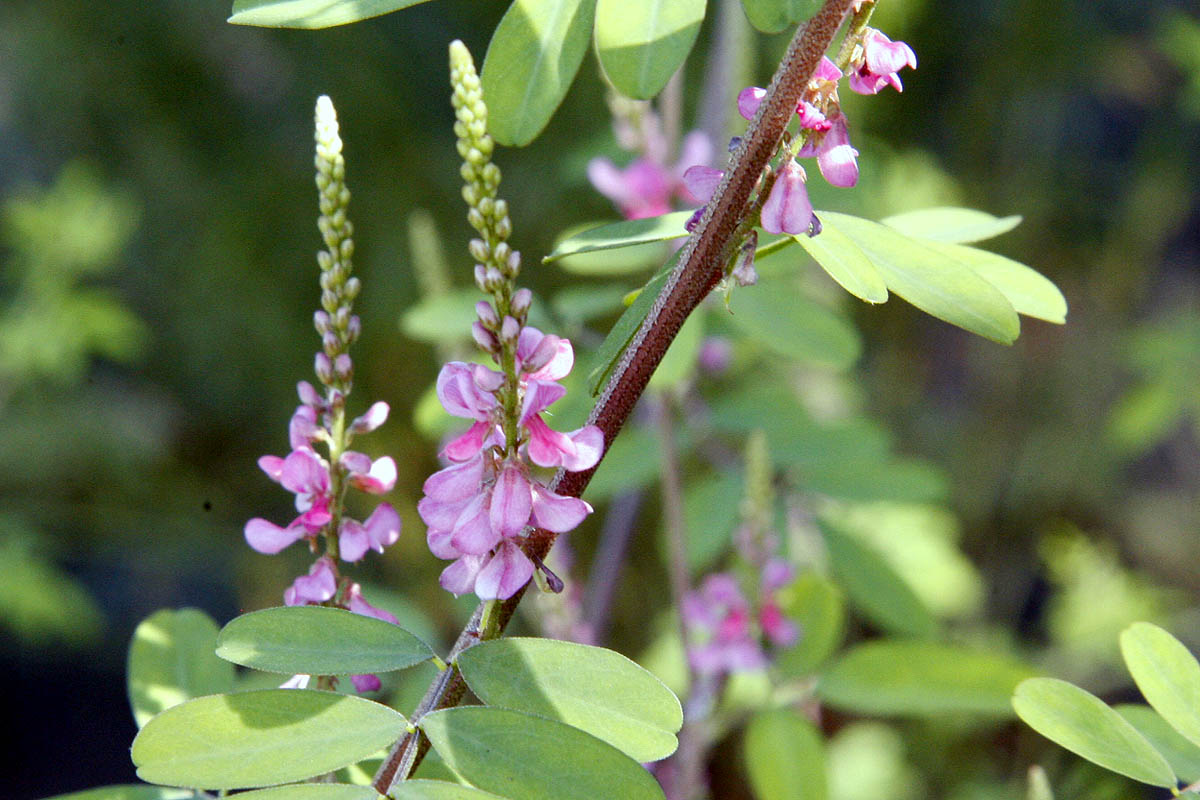
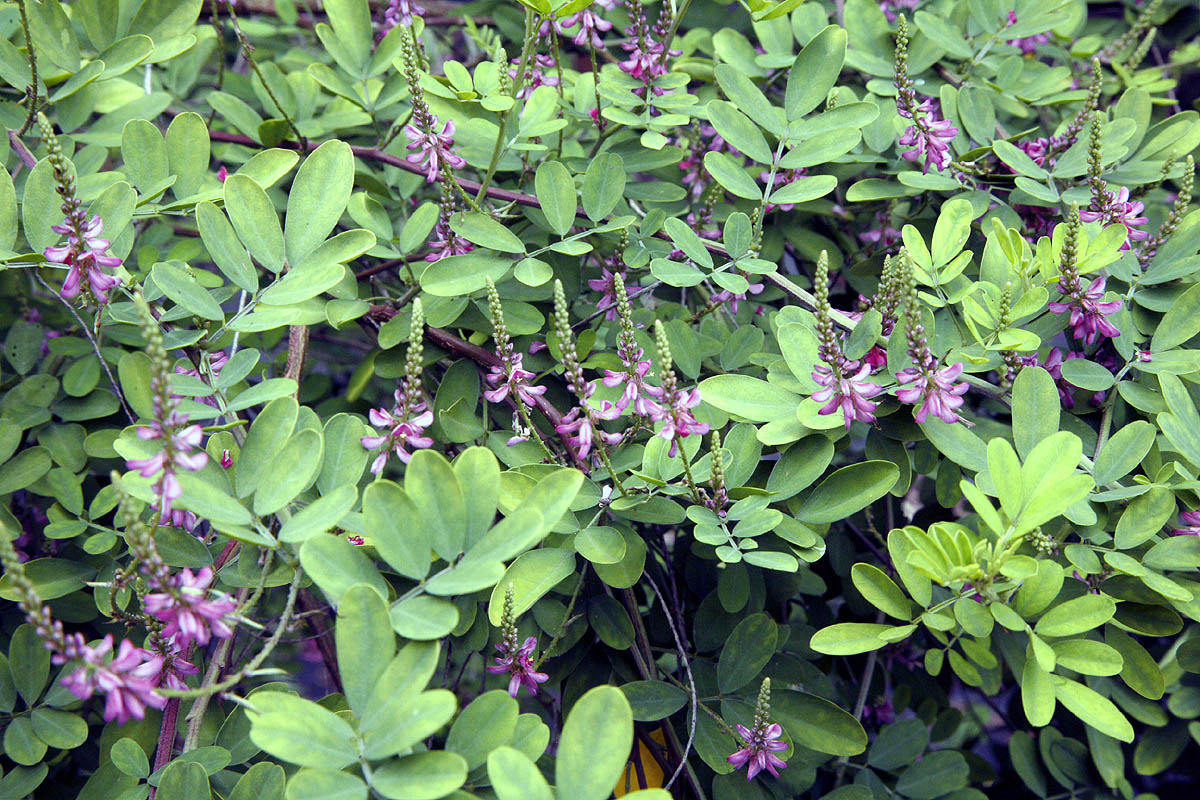
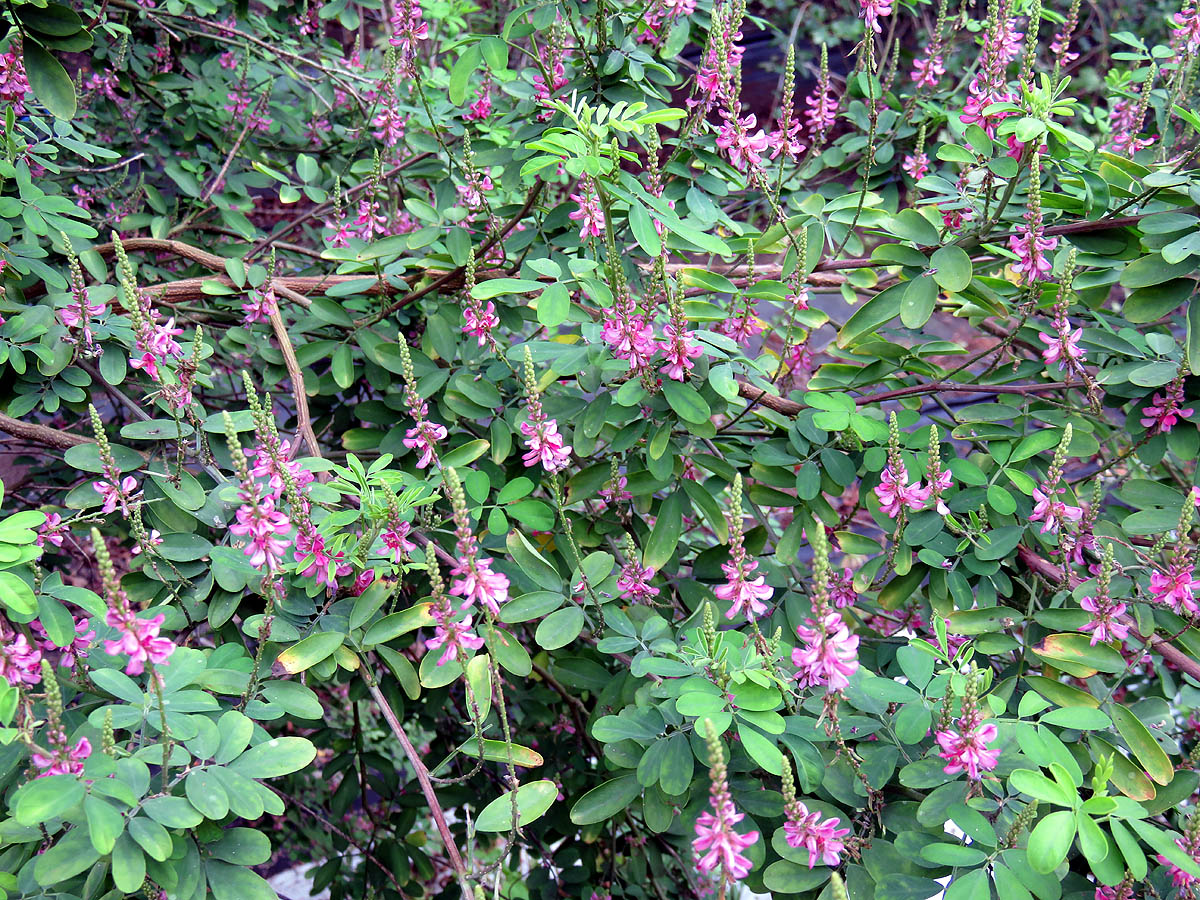
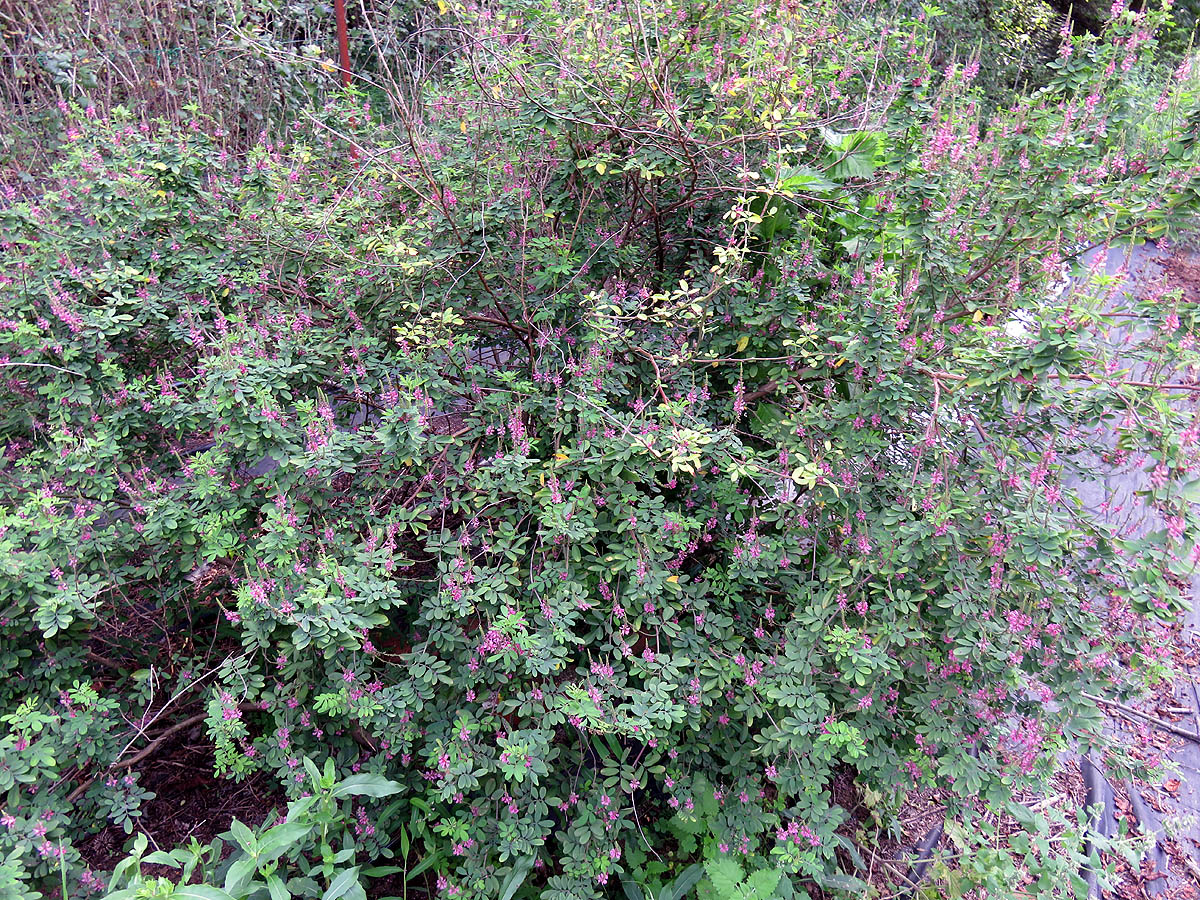
Delightful shrub that produces spikes of pink/purple flowers from early summer until mid to late fall/autumn. hardy to zone 5b where it will need full sun and some shelter from winds but in warmer zones will grow in light to medium shade and still produce prolific flowers. Its unusual that shrubs flower for so long so this is an ideal addition to any garden that wants flowers and especially nectar for butterflies, bees and hummingbirds. Not really fussy about soil type but it has to be well drained and once established is fairly drought tolerant. Does not need much care in warmer zones where it may act as semi evergreen colder zones may need to have small branches pruned off if they get too cold. Does need a little cold treatment before it will germinate but we do this for you! Deer don't seem to eat it.
Description of Himalayan Indigo (Indigofera heterantha).
Hardy small deciduous shrub with thin arching branches growing to the height of 10 feet (3 m). Produces small pinnate leaves 2-4 inches (5-10cm) long. These are composed of 13-21 oval shaped leaflets each of which is 0.4-0.6 inches (1-1.5cm) long and arranged in opposite pairs along the central stem with a single terminal leaflet. Leaves are gray green and covered in small grey hairs on both sides. From summer until late fall it produces small but showy purple to pink pea like flowers in groups of 24 or more in erect spikes up to inches (2-5cm) long. These spikes arise from the leaf axils of all branches beginning at the lowest portion of the branch and blooming upwards towards the top of the branch. Flowers are followed by long cylindrical seed pods 0.5-1 inches (1.3-2.5?cm) long, narrow and clustered in star like groups on the branches. Seed pods tend to remain on the shrub throughout the winter only dropping to the ground in very early spring just before the leaves re-emerge. Himalayan Indigo is a member of the legume family and produces nitrogen fixing nodules on its roots enhancing the soil around it and any plants in its vicinity.
Growing Himalayan Indigo (Indigofera heterantha) from Seed.
Seeds have a fairly hard coat so its best to soak them for 24 hours before planting to ensure they swell up. If some do not remove them and dry them on gently paper towels then use the sandpaper method to carefully scarify the seeds before attempting another soak. Once seeds have swollen they are ready for planting. Sow in good seeding mix and place in good light in warm area between 65-72 F (18-22C) keep moist. We recommend sowing in small pots or cell trays to ensure each seed has time to develop. Germination can be erratic with some seeds sprouting within a few weeks and others can take several months. Some may even want to wait until the next growing season or just be late in the year. Providing each seed with its own development area ensures that those that to germinate do not adversely affect their sleeping brethren when they are transplanted into larger pots.
Grow on in pots until large enough to handle. Pots can be moved outside but keep in semi shaded spot to ensure there is no sunburn. Small plants are used to being in the understory and do not do well in full sun when young. Only transplant out when they are at least 5 inches (13cm) tall. If this takes most of the year overwinter in pots in a cool but not freezing building, and keep moist until spring. Some sources recommend that first year seedings are kept out of frost but we have not found this necessary provided they are large enough to transplant out. Those still in pots should be protected from freezing.
Location and Care of Himalayan Indigo (Indigofera heterantha).
Very cold hardy down to about 5 F (-15C) which is about zone 6a maybe 5b in sheltered spots. It will also grow down to about zone 8. In coldest areas it may die back to larger branches with the tips of branches or even full branches dying back. In 6a or 5b its possible it may die back to the ground and re-sprout in springtime. In warmer zones like 8 it may become semi evergreen while in all other zones it will shed its leaves in late fall.
Light. while reports state full sun ours grow well in semi shaded areas and the ones in full sun (zone 7b) do not do as well. We therefore recommend shade or partial shade for zones 7-8. North sides of buildings dappled shade of trees with full sun only in morning and /or evening. In cooler zones more sunlight will be tolerated and zone 6a and 5b should have full sun but in a sheltered location to keep very cold winter winds away.
Soil. Needs a well draining lighter soil that is well draining. Does not do well in heavy clay soils or any that holds water for long periods. Not really fussy about soil type and will do quite well on poor soils. Too much fertilizer encourages rapid growth which may not be desirable over time.
Water. Light watering produces best results especially in smaller shrubs but its fairly drought tolerant once established and little extra water is required. However the profuse flowering will be reduced if water is scarce. Do not overwater as this can rot the roots.
Care and pruning. In cold areas cut out all the dead branches in springtime. If the area is quite cold (5b-6a) it can be cut down to the ground every winter. This will encourage a flush of new shoots every springtime.
In warmer areas only some light pruning of dead branch tops or dead branches is needed. It blooms on new wood so prune early in the year to encourage more newer shoots. It rarely needs fertilizer since it will fix its own nitrogen.
Pollinator and Wildlife with Himalayan Indigo (Indigofera heterantha).
Since it begins flowering in late spring early summer pollinators like it because it is a constant source of nectar flowering for very long periods its a good regular stopping place for hummingbirds.
Culinary Uses of Himalayan Indigo (Indigofera heterantha).
Flowers are edible and considered a delicacy in Himalayan cuisine. The flower buds have a bean like flavor. They are also pickled or curried for later use.
Medical uses of Himalayan Indigo (Indigofera heterantha).
While not used in medicine much in the west it has long been used in Himalayan and sub-Himalayan regions mostly for gastrointestinal and pain disorders. The roots and bark are used. Recent research has found it has strong antibacterial, antifungal and antiviral activity. Other research showed significant antioxidant capacity (free-radical scavenging) and increase in glucose update in yeast cells suggesting possible uses for diabetics. The traditional use for gastric pain, stomach ache, colic, gastric disorders and dyspepsia are also supported by more recent research that also shows potential for issues with ulcers and liver support. Mild extract are also used in eastern medicine to treat headaches, chest congestion, toothache and abdominal cramps.
Other uses of Himalayan Indigo (Indigofera heterantha).
Like all plants in this group it will produce a blue dye mostly from the leaves. This species is not used as often at others most likely because it is smaller and slower growing than its more tropical brethren.
The wood is very flexible and is ideal for making baskets, fences and small branches are also chewed as toothbrushes in rural areas.
Other names.
Himalayan indigo, indigo bush